
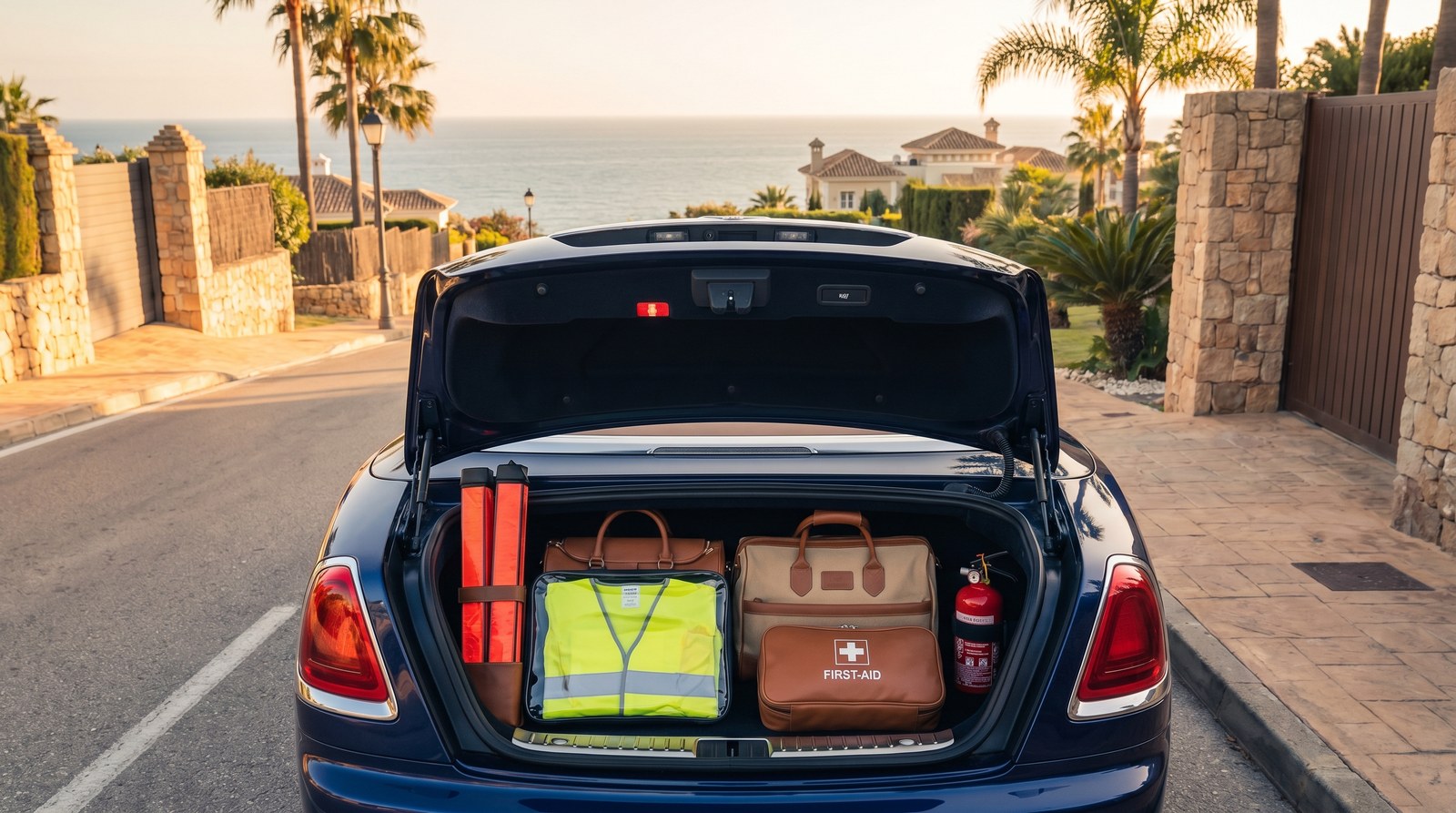
Whether you’re arriving in Marbella behind the wheel of a rental supercar or driving your own vehicle along the Costa del Sol, understanding Spain’s mandatory safety equipment requirements isn’t just about legal compliance—it’s about protecting yourself and your passengers on some of Europe’s most scenic coastal roads. Spanish traffic law mandates specific emergency equipment in every vehicle, with regulations that have evolved significantly since 2021 and will change again in 2026.
This guide breaks down exactly what you must carry, when you need to use it, and how upcoming regulatory changes will affect drivers throughout Spain—from the winding mountain roads of La Zagaleta to the coastal highways connecting Puerto Banús with Estepona.
Warning Triangles and the New V-16 Light System
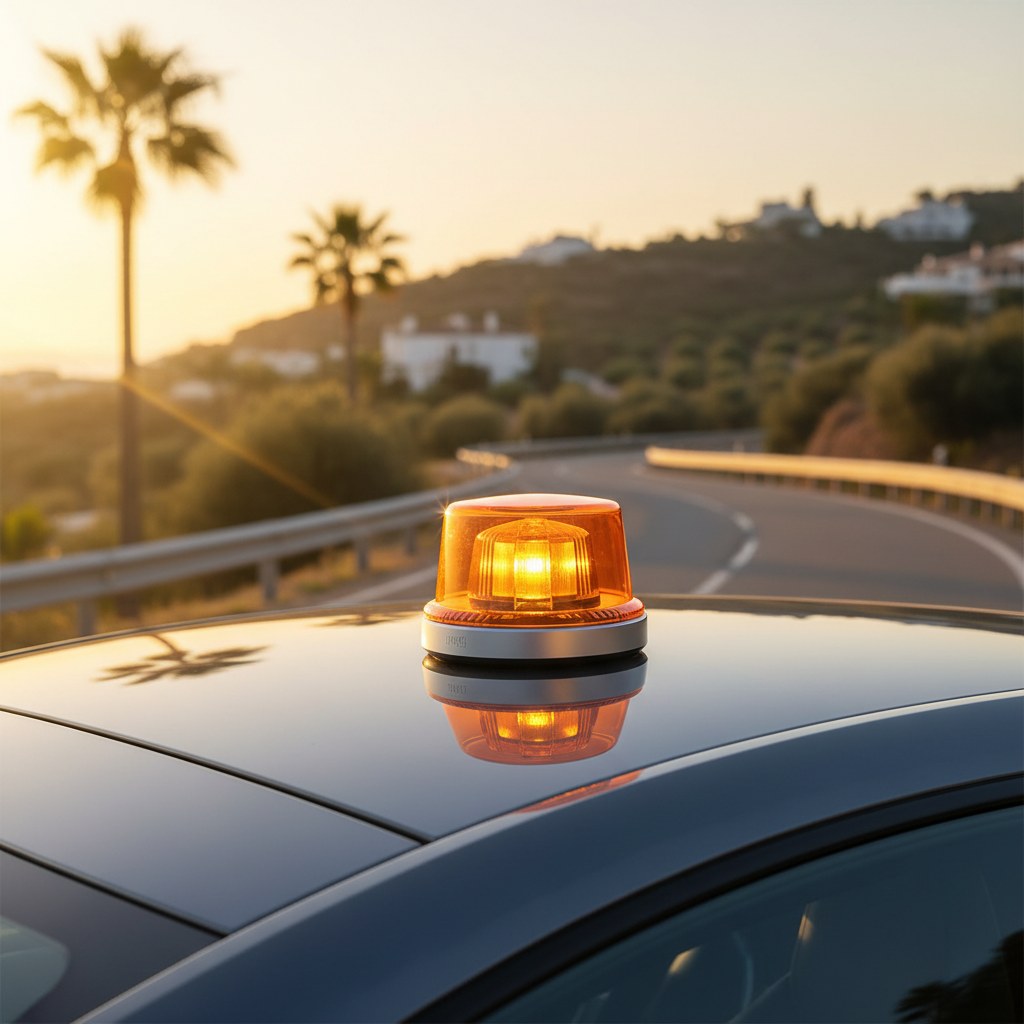
Spain’s approach to roadside warnings is in the midst of a major transition. The traditional warning triangle system is being phased out in favor of modern V-16 emergency beacons, a change designed to reduce the number of pedestrian accidents on Spanish highways.
Currently, all vehicles must carry at least one approved warning triangle. However, vehicles with Spanish registration plates must carry two triangles—a requirement that catches many foreign drivers off guard. The triangle must be placed at least 50 meters behind your vehicle when you break down outside built-up areas, positioned to be visible from 100 meters away. On two-way roads, Spanish-registered vehicles and rental cars must place a second triangle 50 meters in front of the vehicle.
Important safety note: If placing a triangle would put you in danger due to heavy traffic or poor visibility, Spanish law does not require you to risk your safety. Remain in your vehicle with hazard lights on and call for assistance.
Since July 1, 2021, drivers have been permitted to use an approved V-16 emergency beacon instead of warning triangles. This compact orange flashing light adheres magnetically to your vehicle’s roof and can be deployed from inside the car through the window—eliminating the need to walk along dangerous roadways. The beacon must be visible from 1 kilometer in all directions and meet specific DGT (Dirección General de Tráfico) approval standards.
The critical date to remember: January 1, 2026. From this date forward, warning triangles will no longer be legally accepted, and the V-16 beacon becomes mandatory for all vehicles in Spain. If you’re planning extended stays in Marbella or considering luxury car rental arrangements, verify that your vehicle is equipped with an approved V-16 device.
Reflective Safety Vests: Requirements and Specifications
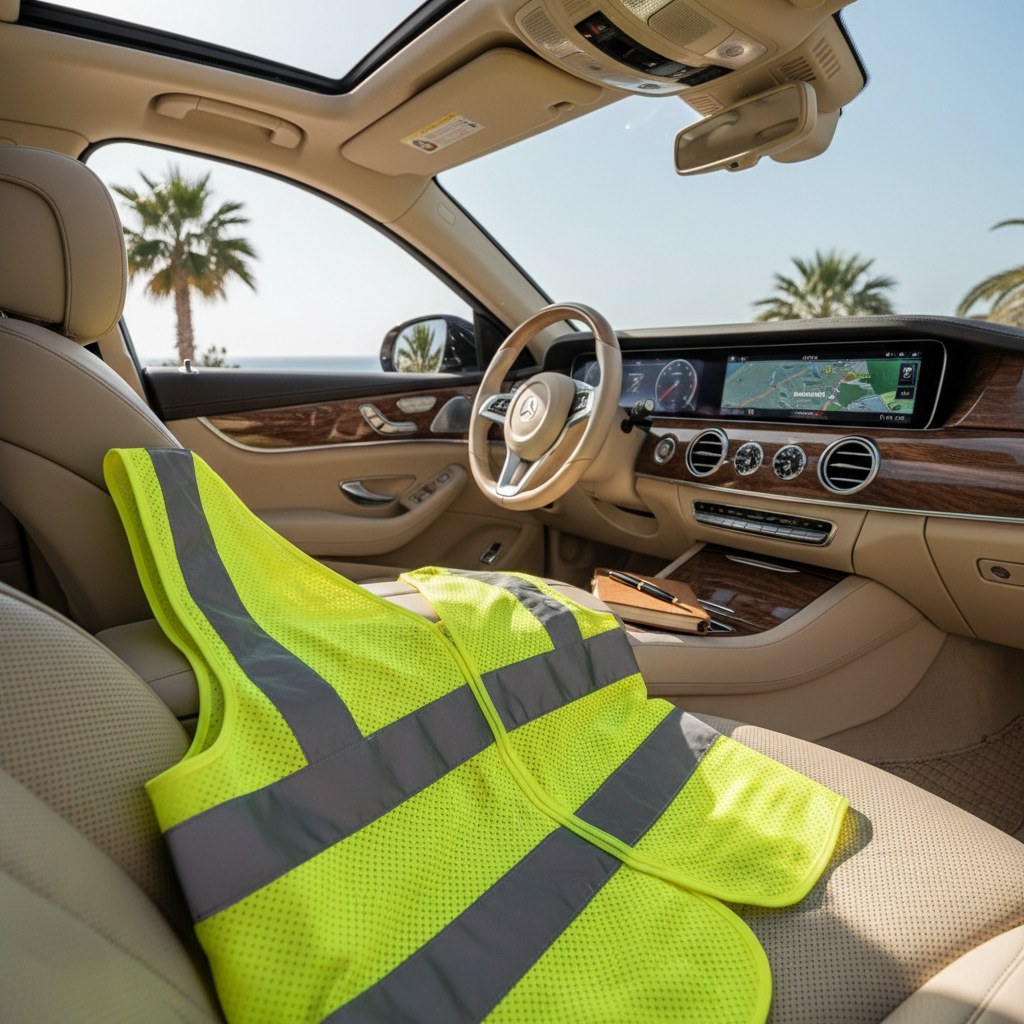
Every vehicle in Spain must carry at least one reflective safety vest, and it must be stored within reach of the driver’s seat—not in the trunk. The logic is straightforward: in an emergency, you need to put on the vest before exiting the vehicle onto a potentially dangerous roadway.
The vest becomes mandatory to wear when you or your passengers exit the vehicle due to breakdown or accident outside built-up areas. This applies to everyone who steps onto the roadway, not just the driver. While technically only vehicles with Spanish plates are required to carry vests, the obligation to wear them applies to all nationalities, making it prudent for every occupant to have one available.
Spanish regulations require vests to meet European standard EN ISO 20471:2013. Compliant vests feature:
- Fluorescent coloring: Yellow, orange, or red high-visibility material
- Retro-reflective stripes: Horizontal bands that reflect vehicle headlights
- Certification marking: CE mark and standard number visible on the vest
- Proper coverage: Adequate torso coverage to ensure visibility from all angles
If you’re renting a luxury villa in Marbella and planning road trips along the Costa del Sol, purchasing additional vests for all passengers is an inexpensive investment in safety. They’re available at any Spanish service station or automotive shop for typically under €5 each.
Spare Wheels and Tire Repair Solutions
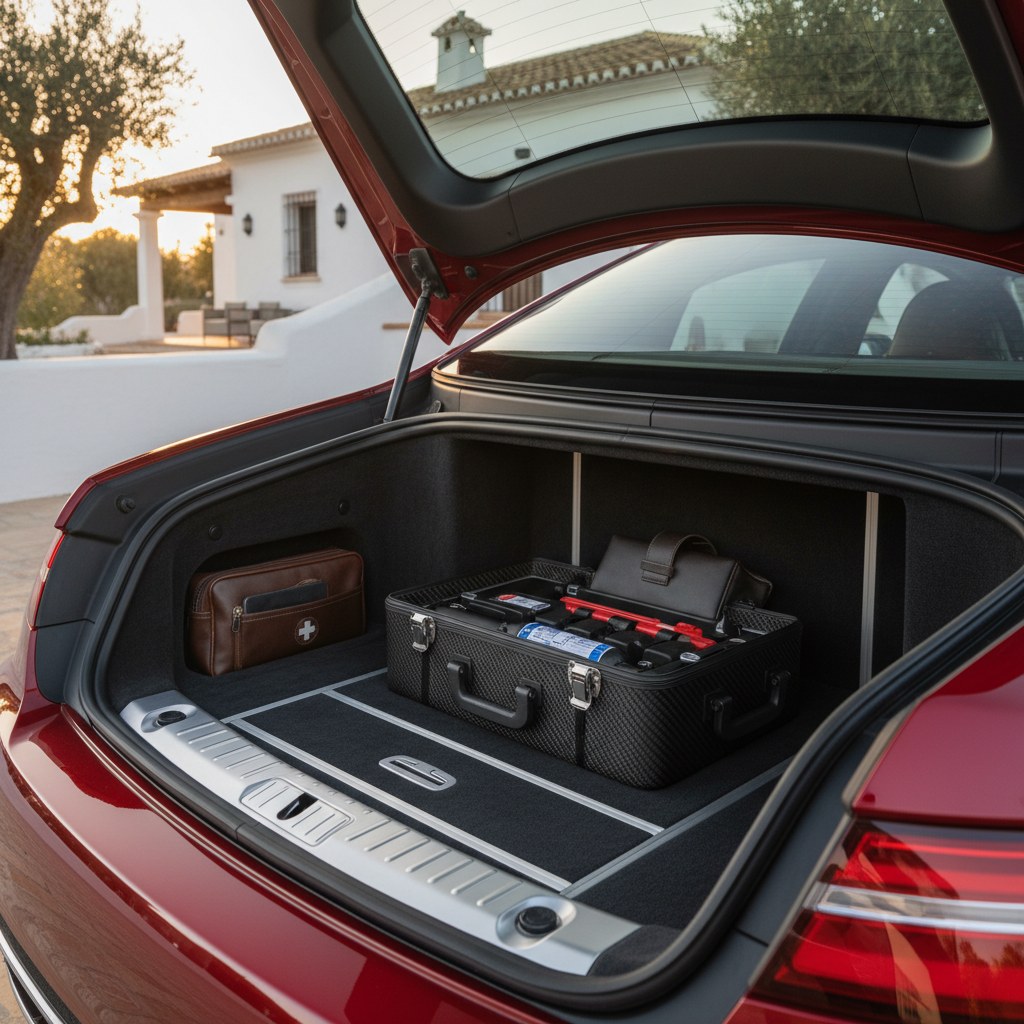
Spanish law requires every vehicle to have a means of addressing tire failure—but it offers flexibility in how you meet this requirement. You must carry either a spare wheel with the proper tools to change it (jack and wheel wrench), or an approved tire repair kit capable of temporarily sealing punctures.
Modern vehicles increasingly come equipped with tire sealant kits rather than traditional spare wheels, a weight-saving measure that improves fuel efficiency. These kits typically include a bottle of sealant compound and a small air compressor. They’re effective for small punctures but cannot address sidewall damage or larger tears.

The spare wheel requirement does not apply to vehicles equipped with run-flat tires—specialized tires designed to operate for limited distances even after losing air pressure. Many high-performance vehicles available through Marbella luxury car rental services use run-flat technology, particularly premium German marques.
Local insight: The mountain roads between Marbella and Ronda, while spectacular, can be tough on tires. If you’re driving through the Serranía de Ronda or exploring inland Andalusia, verify your spare tire or repair kit is functional before departure—mobile coverage can be spotty in mountainous areas.
Before setting out on longer journeys from the Costa del Sol—whether toward Granada, Seville, or along the coastal route to Málaga—take a moment to locate your spare tire or repair kit and confirm you have the necessary tools. This simple check can prevent hours of roadside frustration.
Fire Extinguishers: When They’re Required
Fire extinguishers are mandatory in Spain only for specific vehicle configurations. If you’re towing a trailer or caravan, you must carry an approved automotive fire extinguisher. The extinguisher must be properly secured, easily accessible, and within its service date.
For vehicles not towing trailers—including standard passenger cars and SUVs—fire extinguishers are recommended but not legally required. However, given the potential severity of vehicle fires and the relatively low cost of a compact extinguisher, many safety experts and insurance providers suggest carrying one regardless of legal obligation.
If you choose to carry a fire extinguisher, ensure it meets these criteria:
- Appropriate type: ABC-rated extinguishers suitable for multiple fire classes
- Adequate capacity: Minimum 1 kg for motorcycles, 2 kg recommended for cars
- Proper mounting: Securely fastened to prevent becoming a projectile in an accident
- Current inspection: Within the manufacturer’s service interval, typically annual checks
- Accessible location: Reachable from the driver’s seat or immediately upon exiting
For those planning extended road trips through Spain or storing a vehicle long-term at a Marbella property, a quality fire extinguisher provides peace of mind well beyond the modest investment.
What You Don’t Need to Carry in Spain
Spanish regulations are notably more relaxed than some European neighbors regarding certain safety items. Unlike Germany, Austria, or several Eastern European countries, Spain does not require vehicles to carry:
- First aid kit: Not legally mandatory, though recommended for remote area travel
- Spare bulbs: No requirement to carry replacement headlight or indicator bulbs
- Breathalyzer: Unlike France, Spain doesn’t require personal alcohol testing devices
- High-visibility vest for every passenger: Only one is legally required, though multiple are advisable
This streamlined approach simplifies compliance for international drivers, though carrying a basic first aid kit remains sensible, particularly if you’re exploring the region’s more remote areas—the villages of the Alpujarras, the Cabo de Gata natural park, or the interior roads of the Sierra de las Nieves.
Special Considerations for Rental Vehicles and Foreign-Registered Cars
Rental vehicles in Spain must comply with the same regulations as Spanish-registered cars, including the requirement for two warning triangles (or V-16 beacon) and multiple safety vests. Reputable rental companies provide this equipment as standard, but it’s worth verifying before departing the rental facility.
Foreign-registered vehicles visiting Spain benefit from slightly relaxed requirements—only one warning triangle is mandatory rather than two. However, the obligation to use safety equipment correctly when needed applies equally to all drivers regardless of registration country. Spanish traffic authorities can and do fine foreign drivers for safety violations.

If you’re bringing your own vehicle to Marbella for an extended stay—perhaps while enjoying a seasonal rental at a luxury Costa del Sol property—ensure your equipment meets Spanish standards. UK and other European safety vests typically comply with the required EN ISO 20471:2013 standard, but verify the certification marking is present and legible.
Enforcement and Penalties
Spanish traffic police (Guardia Civil de Tráfico) actively enforce safety equipment requirements, particularly during roadside checks on major highways and popular tourist routes along the Costa del Sol. Fines for non-compliance are standardized and non-negotiable:
- Missing warning triangle or V-16 beacon: €200 fine
- Failure to use warning devices when required: €200 fine
- Missing safety vest: €200 fine
- Not wearing safety vest when mandatory: €200 fine
- Missing spare wheel/repair kit: €200 fine
These penalties apply per violation, meaning multiple infractions during a single stop can result in substantial fines. More importantly, lacking proper safety equipment during an actual emergency can have consequences far more serious than financial penalties.
The Guardia Civil conducts regular safety campaigns, particularly before major holiday periods when traffic volumes peak on routes connecting Marbella with Madrid, Seville, and other major cities. Summer months and Semana Santa (Holy Week) see increased enforcement activity throughout Andalusia.
Practical Tips for Marbella Visitors and Residents

Ensuring compliance with Spanish safety regulations requires minimal effort and expense. Before embarking on any significant journey from Marbella, conduct a quick vehicle check:
- Verify equipment presence: Confirm warning triangle/V-16, safety vest, and spare tire/repair kit are in the vehicle
- Check equipment condition: Ensure vests aren’t faded or damaged, triangles are intact, and tire repair kits haven’t expired
- Confirm accessibility: Safety vests must be reachable from the driver’s seat, not buried in luggage
- Update for 2026: If your vehicle still relies on warning triangles, plan to acquire an approved V-16 beacon before the January 2026 deadline
- Consider extras: Additional safety vests for all passengers and a first aid kit enhance preparedness
For those utilizing chauffeur services or professional transport in Marbella, these concerns are handled by your service provider. Professional drivers maintain vehicles in full legal compliance, allowing you to focus entirely on enjoying your Costa del Sol experience.
Why Marbella Hospitality Is Your Trusted Partner for Luxury Transport

When you arrange vehicle services through Marbella Hospitality, every detail—from legal compliance to immaculate presentation—is handled by our dedicated team. Our supercar rental fleet and chauffeur vehicles maintain the highest safety standards, with all mandatory equipment inspected regularly and V-16 emergency beacons already installed ahead of the 2026 requirement. Whether you’re arriving for a weekend at a luxury villa, boarding a yacht charter, or simply exploring the region, our concierge team ensures your ground transportation exceeds both legal requirements and luxury expectations.
Plan Your Marbella Experience With Complete Confidence
Understanding Spain’s safety equipment requirements is just one aspect of a seamless Marbella experience. Whether you’re navigating these regulations in a rental vehicle or leaving all logistics to professional services, the goal remains the same: enjoying everything the Costa del Sol offers without distraction or concern.
For comprehensive support with luxury transport, villa bookings, yacht charters, or any aspect of your Marbella visit, contact the Marbella Hospitality concierge team. We handle the details so you can focus entirely on the experience.