

Marbella’s geography makes a car essential. Stretching over 27 kilometers of coastline from San Pedro de Alcántara to Cabopino, with attractions scattered from the Golden Mile to the hills of Sierra Blanca, the city’s layout demands independent mobility. While taxis and ride-shares exist, anyone planning more than a day or two in Marbella quickly discovers that car rental in Marbella transforms a logistical challenge into effortless freedom—whether you’re commuting between beach clubs, exploring mountain villages, or simply navigating the sprawl between Puerto Banús and Elviria.
This guide distills years of local expertise into a practical roadmap for securing the right vehicle, understanding Spanish rental protocols, and driving confidently on the Costa del Sol. From documentation requirements to fuel policies, we’ll cover what matters most to luxury travelers who expect seamless service and zero surprises.
Why You Need a Car in Marbella

Marbella is not a compact city center you can traverse on foot. The main attractions—Nikki Beach, Finca Cortesín, the old town, Puerto Banús marina, and upscale residential zones like Nueva Andalucía and Los Monteros—are separated by significant distances. Public transport is limited to local buses that run infrequently, and taxis, while available, become costly for multiple daily trips.
A rental car grants access to the region’s hidden gems: the white villages of Ojén and Istán, the mountain roads to Ronda, secluded beaches beyond Cabopino, and golf courses scattered across the coastal plain. For villa guests, a vehicle is non-negotiable—most luxury properties sit in gated communities several kilometers from the nearest restaurant or supermarket.
Insider tip: If you’re staying in a hillside villa above the A-7 highway, factor in steep, narrow access roads. A compact or mid-size vehicle often handles these better than a full-size sedan, despite the allure of upgrading.
Essential Pre-Rental Checklist for Car Rental in Marbella
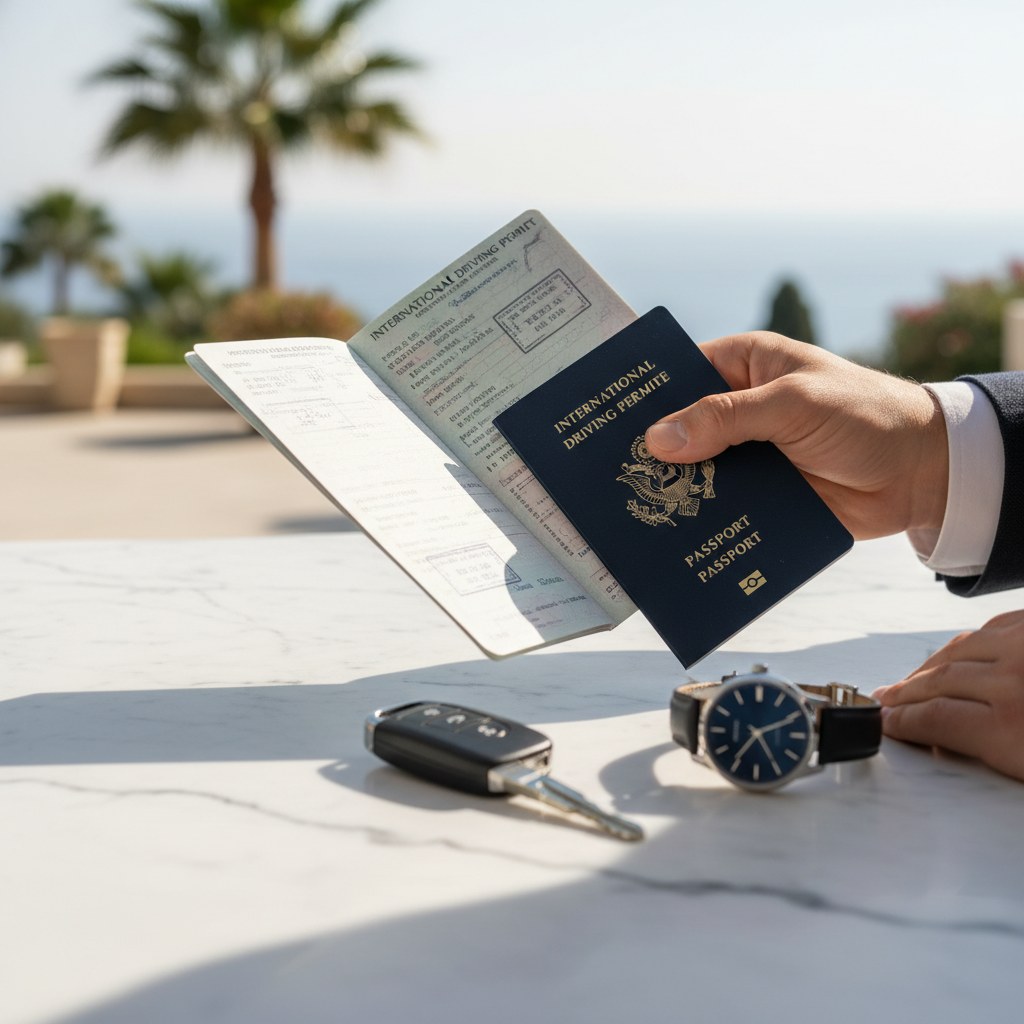
Preparation eliminates stress. Before you book, verify these fundamentals to ensure eligibility and avoid last-minute complications at the rental desk.
- Valid driving license: EU licenses are accepted without question. Visitors from the UK, USA, Canada, Australia, and New Zealand need their national license plus an International Driving Permit (IDP) if staying longer than six months or if the license is not in Roman alphabet. Short-term tourists often skip the IDP without issue, but having one provides legal cover.
- Age requirements: Most agencies require drivers to be at least 21 years old, with a young driver surcharge (typically €10–€25 per day) applied until age 25. Luxury and high-performance vehicles often require drivers to be 25 or older with at least two years’ experience.
- Credit card in driver’s name: A credit card—not debit—is mandatory for the security deposit, which ranges from €500 to €3,000 depending on vehicle class. The hold is released 7–14 days after return.
- Insurance coverage: Spanish law requires third-party liability insurance (included in all rentals). Collision Damage Waiver (CDW) and theft protection are standard but come with an excess (deductible) of €800–€1,500. Consider purchasing full coverage (Super CDW) to eliminate the excess entirely, especially for higher-value vehicles.
- Advance booking: Reserve at least two weeks ahead during low season (November–March) and four to six weeks for high season (June–September). Peak periods like Semana Santa (Easter week) and August see prices double and availability vanish.
For seamless arrangements that include vehicle delivery to your villa or yacht, Marbella Hospitality’s concierge services coordinate every detail, from paperwork to doorstep handover.
Choosing the Right Vehicle Category

Marbella’s rental market spans economy hatchbacks to Lamborghinis and Bentleys. Your choice should align with your itinerary, passenger count, and the statement you wish to make.
Economy & Compact (€25–€45/day)
Ideal for solo travelers or couples planning urban exploration and short coastal drives. Models like the Seat Ibiza, Peugeot 208, or Volkswagen Polo offer excellent fuel economy (5–6 L/100km) and easy parking in tight old-town streets. Drawbacks: limited luggage space and less comfort on longer highway stretches to Granada or Seville.
Intermediate & Standard (€40–€60/day)
The sweet spot for most visitors. Vehicles like the Volkswagen Golf, Audi A3, or BMW 1 Series balance space, comfort, and performance. Suitable for families of four with moderate luggage, and refined enough for arrival at upscale venues without feeling underdressed.
Full-Size & Premium (€60–€100/day)
For those prioritizing comfort on longer drives or traveling with more luggage. The BMW 3 Series, Mercedes-Benz C-Class, and Audi A4 deliver a premium experience with advanced features, spacious interiors, and the prestige expected when pulling up to a Puente Romano or Marbella Club valet stand.
Luxury & Exotic (€150–€1,000+/day)
Marbella is synonymous with supercar culture. Renting a Ferrari 488, Porsche 911, Lamborghini Huracán, or Rolls-Royce Wraith transforms driving into an event. These vehicles require higher deposits, stricter age limits (often 30+), and comprehensive insurance. Expect delivery services, dedicated account managers, and mileage caps (typically 150–250 km/day). For curated supercar experiences, explore Marbella’s luxury car rental options through our network of vetted providers.
SUVs & Convertibles
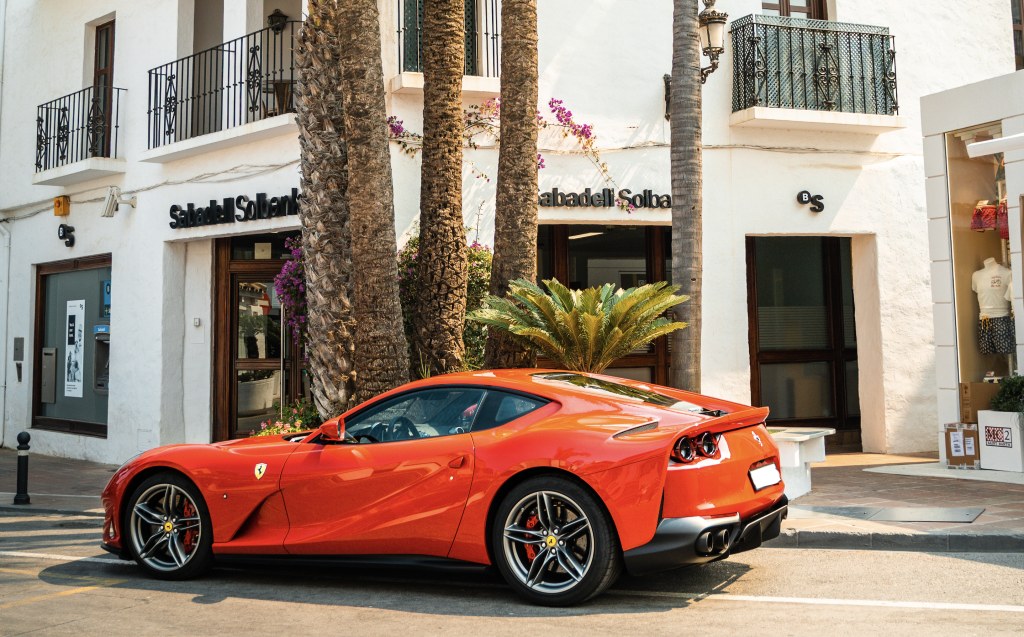
SUVs (€70–€150/day) like the Range Rover Sport or Porsche Cayenne suit families or groups needing space and elevated road position. Convertibles (€80–€200/day)—think BMW 4 Series Cabrio or Mercedes SL—are perfect for coastal drives along the A-7 with the Mediterranean breeze, though less practical for airport runs with multiple suitcases.
Best Practices When Renting Your Vehicle
These protocols protect you from disputes and ensure a smooth handover and return process.
Inspect Thoroughly Before Accepting
Walk around the vehicle with the agent, photographing or filming every angle, including wheels, undercarriage, windscreen, and interior. Document existing scratches, dents, and tire condition. Check that the fuel tank matches the level stated on the contract (usually full). Verify that the spare tire, jack, warning triangle, and reflective vest are present—Spanish law requires them.
Understand the Fuel Policy
Most Marbella agencies operate a full-to-full policy: you receive a full tank and return it full. Failing to refuel incurs hefty charges (€2–€3 per liter plus service fees). Some budget operators offer full-to-empty (you prepay a tank and return it empty), which rarely works in your favor unless you time it perfectly. Always refuel at a nearby station before drop-off—there’s a Repsol on Avenida Severo Ochoa near the airport and a Cepsa on the A-7 at San Pedro.
Clarify Mileage Limits
Standard rentals typically include unlimited mileage, but luxury and exotic vehicles often cap daily distance at 150–250 kilometers, with overage fees of €1–€5 per extra kilometer. If planning excursions to Ronda (60 km each way), Seville (210 km), or along the coast to Nerja (90 km), confirm limits upfront or negotiate an upgrade.
Add Drivers if Necessary
Additional drivers cost €5–€10 per day but provide flexibility and share the responsibility. Each driver must present a valid license and meet age requirements at pickup.
Opt for Comprehensive Coverage
The base CDW leaves you liable for the excess. Upgrading to Super CDW or Zero Excess (€15–€40/day depending on vehicle) eliminates this risk. For luxury cars, it’s non-negotiable—a single scrape on a Bentley Continental can trigger a €3,000 excess charge. Some credit cards offer rental car insurance; verify coverage limits and exclusions for Spain before relying on it.
Local insight: Parking in Puerto Banús and Marbella old town is tight and chaotic in summer. Valet services at beach clubs and restaurants are common (€5–€10 tip expected). If self-parking, use official car parks to avoid fines—street enforcement is strict.
Driving in Marbella: Rules, Roads & Realities
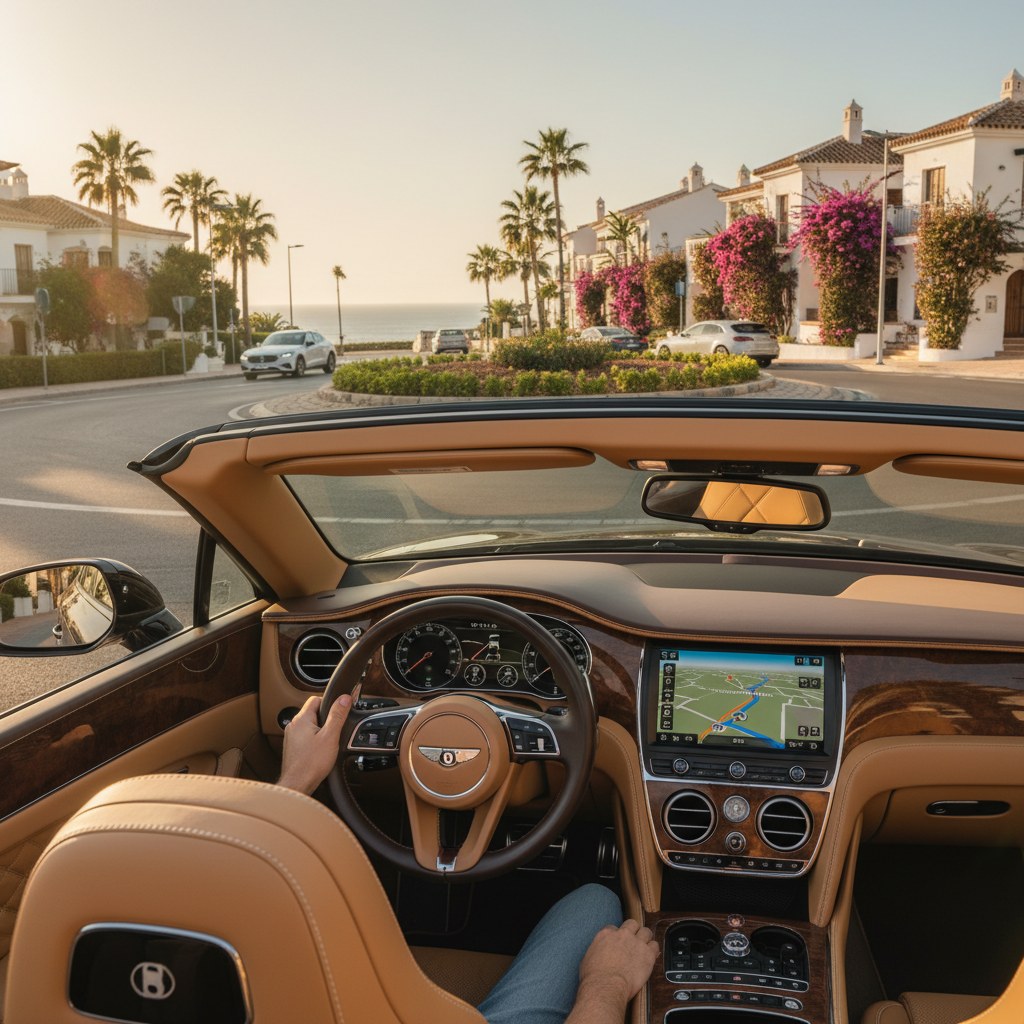
Spanish driving regulations are stringent, and enforcement in Marbella is rigorous, particularly during high season when traffic police patrol heavily.
Key Traffic Laws
- Speed limits: Urban areas 50 km/h, secondary roads 90 km/h, dual carriageways 100 km/h, motorways (A-7, AP-7 toll road) 120 km/h. Cameras are common, and fines start at €100, escalating with severity.
- Alcohol limit: 0.5 g/L blood alcohol (0.25 mg/L breath), lower than the UK and USA. For new drivers (license less than two years), it’s 0.3 g/L. Penalties range from €500 fines to license suspension. The safest rule: don’t drink and drive.
- Mobile phones: Handheld use is illegal (€200 fine, 3 points). Use Bluetooth or pull over.
- Seat belts: Mandatory for all passengers, front and rear. Children under 135 cm must use appropriate child seats.
- Roundabouts: Yield to traffic already in the roundabout (right of way). Use the outer lane for first exit, inner lane for later exits, signaling when exiting.
Navigating Marbella’s Road Network
The A-7 (Autovía del Mediterráneo) is the coastal artery, free and often congested between San Pedro and Fuengirola during rush hours (8–10 AM, 6–8 PM). The parallel AP-7 toll motorway offers faster, quieter travel; tolls from Marbella to Estepona cost around €2, to Málaga approximately €7. For scenic drives, take the A-355 inland to Ojén and Istán, or the coastal N-340 (old coast road) through traditional towns, though it’s slower and winding.

Parking can be challenging. The old town has limited street parking (blue zones require payment via app or meter, €1–€2/hour, max 2 hours). Underground car parks at Avenida del Mar and Plaza de los Naranjos charge €1.50–€2.50/hour. In Puerto Banús, arrive early or use the multi-story car park behind El Corte Inglés. Most beach clubs and high-end restaurants offer valet or dedicated parking—confirm when booking your VIP table reservations.
What to Avoid
- Don’t ignore damage: Even minor scrapes must be reported immediately to the rental agency and police if another party is involved. Failing to document damage can void your insurance.
- Don’t exceed mileage caps: GPS tracking in luxury vehicles monitors distance. Overage fees add up quickly.
- Don’t return late: Grace periods are typically one hour. Beyond that, expect charges for an additional rental day (often at a higher walk-in rate).
- Don’t assume coverage: Personal auto insurance from your home country rarely extends to European rentals. Verify before declining agency coverage.
Seasonal Pricing & Booking Strategy
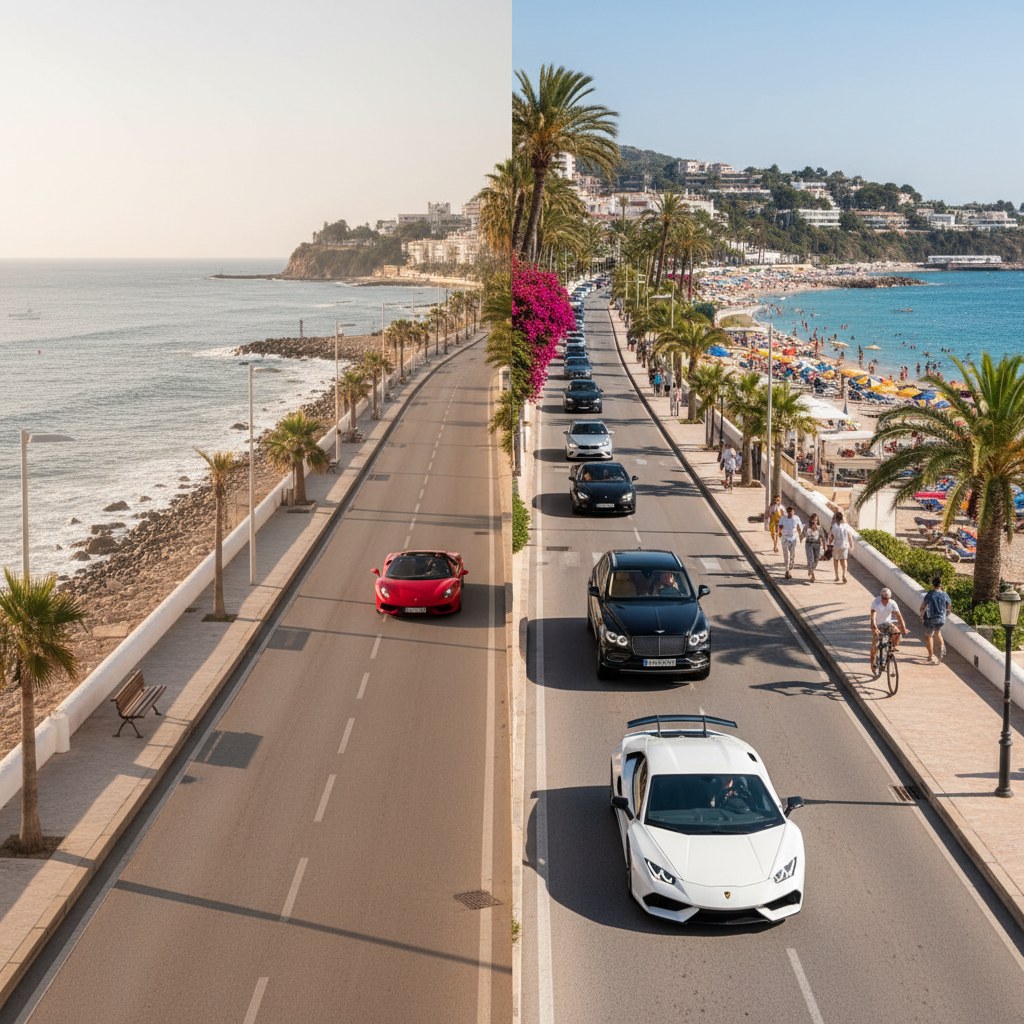
Car rental rates in Marbella fluctuate dramatically by season, vehicle class, and booking lead time.
Low Season (November–March)
Expect the best value: economy cars from €20–€30/day, mid-size sedans €30–€45, premium models €50–€80, and luxury vehicles €100–€150. Availability is high, and last-minute bookings are feasible. Weather remains mild (15–20°C), ideal for exploring without the summer crowds.
High Season (April–June, September–October)
Rates climb: economy €30–€40, compact €35–€50, intermediate €45–€60, luxury €150–€250. Book 4–6 weeks ahead to secure preferred models. April’s Semana Santa and October’s pleasant weather draw significant demand.
Peak Season (July–August)
Prices peak and availability tightens. Economy cars reach €40–€50, standard sedans €60–€80, and exotic rentals €200–€1,000+. Book 8–12 weeks in advance. Last-minute rentals may only offer overpriced or unsuitable vehicles. For luxury travelers arriving via yacht charter or staying in premium Marbella villas, advance coordination through a concierge ensures the right vehicle awaits upon arrival.
Where to Rent
Málaga-Costa del Sol Airport (AGP), 45 kilometers east of Marbella, hosts all major agencies: Hertz, Avis, Europcar, Sixt, Enterprise, plus local operators. Picking up at the airport is convenient for immediate onward travel. Alternatively, many agencies deliver to Marbella hotels or villas for a fee (€30–€80 depending on distance). For bespoke service—vehicle selection, paperwork handled in advance, delivery to your luxury villa—concierge-arranged rentals eliminate queues and confusion.
Why Book Your Car Rental Through Marbella Hospitality

While booking directly with agencies is straightforward, our concierge service elevates the experience for discerning clients who value time and precision. We secure preferred rates with vetted luxury and standard rental partners, arrange doorstep delivery and collection, handle all documentation in advance, and provide 24/7 support should any issue arise during your rental period. Whether you need a discreet executive sedan for business meetings or a head-turning supercar for a coastal tour, our team ensures the right vehicle, at the right price, exactly when and where you need it—allowing you to focus entirely on enjoying Marbella.
Final Considerations for a Seamless Experience
Successful car rental in Marbella hinges on preparation, clear communication, and attention to detail. Confirm your license and insurance coverage weeks before departure. Book early to secure both availability and competitive pricing. Inspect your vehicle meticulously at pickup, and drive within the legal and contractual parameters. Return the car on time, clean, and fueled to avoid surprise charges.
For travelers juggling villa check-ins, yacht charters, restaurant reservations, and event access, coordinating vehicle logistics independently can be a distraction. Marbella Hospitality integrates car rental into a comprehensive service package—from airport transfer in a chauffeur-driven Mercedes S-Class to a weekend Ferrari for the coastal drive to Sotogrande, every detail is managed with the same precision we apply to VIP table bookings and yacht charters.
Ready to arrange your vehicle and elevate your Marbella experience? Contact our concierge team to discuss your requirements and receive a tailored proposal that ensures seamless mobility from the moment you arrive on the Costa del Sol.